Accurate, transparent financial reports build trust with your board, funders, and the community you serve. They also give you the data to make smarter calls about where to allocate limited resources.
For smaller teams juggling multiple roles, pulling together financial data can feel like one more thing on an already long list of responsibilities. But by breaking the process into a few consistent habits, compiling these statements becomes much more manageable. In this guide, we'll break down six key steps to simplify your nonprofit's financial reporting and build reliable processes.
In This Guide
1. Organize a Clear Chart of Accounts
Reliable financial reporting starts even before you compile your first statement. An organized tracking system lets your team monitor incoming funds and outgoing costs without a scramble every time tax season rolls around.
A chart of accounts (COA) is a complete list of your organization's financial accounts, organized in a table. As Jitasa's guide to nonprofit chart of accounts explains, a well-built COA makes it easier to categorize transactions correctly, and the data it contains feeds into all four of your core financial statements.
Organize your COA around these five primary categories:
- Assets
- Everything your organization owns, such as cash, property, and accounts receivable.
- Liabilities
- Everything your organization owes, including debt, deferred revenue, and accounts payable.
- Net assets
- Represent what your nonprofit is worth, which is calculated by subtracting your total liabilities from your total assets.
- Revenue
- All of the funding your organization receives from sources such as individual donations, corporate giving, earned income, investment returns, and grants.
- Expenses
- All of the funding your organization spends on mission-related activities, administrative needs, and the upfront costs of fundraising campaigns.
This structure keeps every transaction sorted into a category your financial professionals will recognize right away. Assign one finance team member to review and approve new account additions before they go into your master system, so you don't end up with duplicate or ambiguous categories down the line.
2. Understand the Four Core Nonprofit Financial Statements
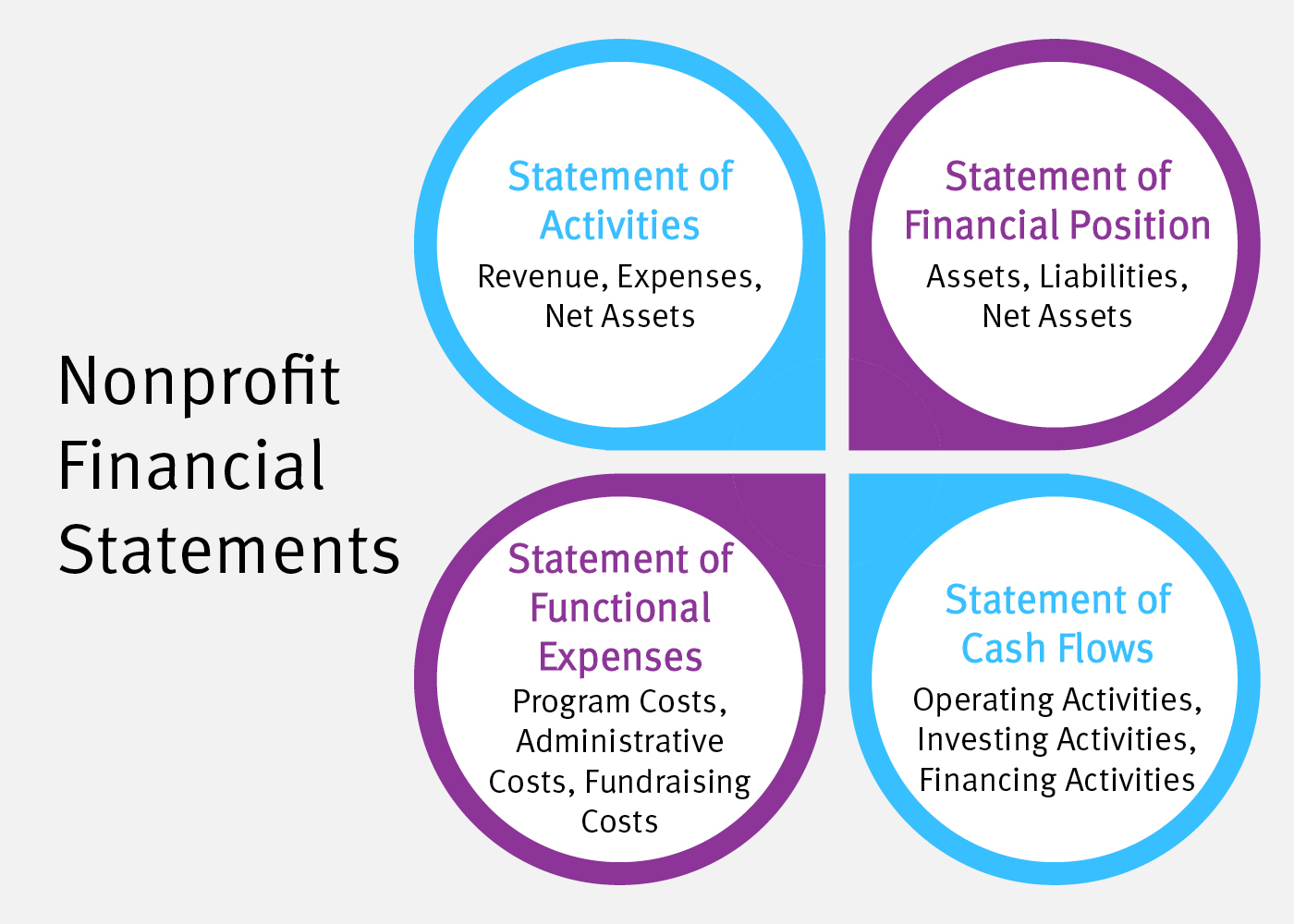
There are four financial statements that form the foundation for all other reporting and together paint a complete picture of your organization's financial health. Before you get into strategies for producing these reports well, your team needs a solid grasp of what each one communicates.
Here is a quick breakdown of what your financial statements include:
Statement of activities
The nonprofit version of a for-profit income statement. It tracks your revenue, expenses, and the resulting change in net assets over a set period.
Statement of financial position
Also known as a balance sheet, this statement provides a snapshot of your assets, liabilities, and net assets at a specific point in time to help you assess your nonprofit's overall financial health and growth potential.
Statement of cash flows
This report tracks how cash moves through your organization via operating, investing, and financing activities, so you can see whether you have the cash on hand to cover what you owe.
Statement of functional expenses
Unique to nonprofits, this statement sorts costs into program, administrative, and fundraising categories to show how each natural expenditure (such as staff salaries or utility payments) furthers your mission.
Review these four statements regularly so your team can catch unexpected trends early enough to act on them, whether that means shifting overhead spending or ramping up fundraising before the fiscal year wraps.
3. Separate Restricted and Unrestricted Funds
Donor intent is one of the trickiest parts of nonprofit accounting to get right. When supporters designate gifts for specific programs or timeframes in their donation agreements, you're legally required to honor those boundaries as you spend their funds.
Temporarily restricted, permanently restricted, and unrestricted funds each need their own classification in your accounting system from the moment they come in. That separation is what lets your statement of activities and statement of financial position accurately show how much of your current funding you can put toward various initiatives and operations.
Accurate tracking of restricted funds is critical to protecting your nonprofit from IRS penalties and potential lawsuits arising from misallocation. Aside from legal compliance, precise financial reporting allows you to show donors exactly how their contributions are advancing your mission. Prioritizing donor transparency not only builds trust but also clearly demonstrates the real-world impact of their support.
Why this matters for teams on Salesforce or Dynamics: When gifts are logged with their restriction details at the point of donation, both your fundraising and finance teams can see which program a donor actually funded. When Soapbox Engage Donations syncs each gift to your CRM in real time, that restriction data stays attached to the record instead of being reconstructed later from a spreadsheet.
4. Categorize Expenses by Function
Tracking what you spend matters for organizational sustainability, but tracking why you spent it is how you know your finances are furthering your mission effectively. Categorizing expenses by function shifts your focus from basic bookkeeping to financial impact by helping you:
Map expenses to mission results
Reassign natural expenses, such as rent, salaries, and office supplies, to functional categories (program, administrative, and fundraising) so stakeholders can see exactly how each dollar advances your mission. For example, if a nonprofit rents a 3,000-square-foot facility where 2,000 square feet is used for community programming and the remaining 1,000 is office space, 67% of their rent would be categorized as a program expense, and the other 33% would be an administrative expense.
Streamline compliance reporting
Because Form 990 requires functional expense reporting, you should use your statement of functional expenses as a direct reference for completing your annual tax return.
Reframe the overhead conversation
Lean on functional expense data to tell your impact story to funders and the community. When questions about overhead come up, this data empowers you to cite real numbers rather than fall back on a defensive explanation.
Resist the urge to artificially shrink administrative costs, or to cut expenditures you can't afford to lose, just to look good on paper. Supporters increasingly understand that strong infrastructure supports sustainable programs, so reporting the true cost of your operations builds more credibility than an unrealistic overhead ratio will.
5. Build Monthly Financial Report Reviews Into Your Routine
Financial reporting shouldn't be something you only think about at tax time or during audit preparation. Regular, consistent check-ins keep your team closely tuned in to where your organization stands financially.
To get started with this process, you can:
- Establish a monthly review schedule. Plan a standing meeting with your board, financial professionals, and leadership to compare your budgeted vs. actual spending and fundraising. Treating reporting as an ongoing practice ensures that unexpected expenses or revenue dips are caught early so you can adjust as needed.
- Shift from reacting to forecasting. Don't just use these check-ins to look backward at what you've already spent. Use your updated actual numbers to adjust your cash flow forecast for the next few months, allowing your team to anticipate and prepare for upcoming financial needs before they become urgent.
- Inform your fundraising strategy. Use these reviews as a natural check-in point for your broader fundraising strategy, and a moment to decide if a mid-year campaign adjustment makes sense.
Remember that regular reviews can also point out areas where your financial situation is better than expected. For example, if expenses for a specific program have been lower than your projections, you may consider expanding that program or reallocating some unrestricted funds that were going toward it to another initiative.
Every gift processed through Soapbox Engage Donations syncs to Salesforce or Microsoft Dynamics in real time, so your monthly review compares against the same records your fundraisers are working from, not a delayed export.
6. Know When to Bring in Specialized Help
As your organization grows, so will its financial management needs, which will likely eventually exceed its capacity. Recognizing when you need outside expertise is a sign of strong, responsible leadership. When making this transition, be sure to choose an external partner that has specific expertise in the nonprofit sector.
Nonprofit reporting comes with its own set of rules: GAAP compliance, fund accounting, and functional expense tracking, all of which differ significantly from for-profit bookkeeping. GAAP applies to every organization, for-profit and nonprofit alike, as a framework for standardization. However, its nonprofit-specific nuances determine how you recognize pledges and in-kind gifts.
An accountant or an outsourced firm that focuses on nonprofits can catch errors early and free up your internal staff's time for mission-focused work. Accurate financial records build the trust major donors need to commit to larger, long-term gifts.
Before you sign with an outsourced partner: Ask to see the reporting templates they've built for organizations of your size and sector. How well they translate dense financial data into understandable reports tells you whether they'll be a strategic partner or just another compliance vendor.
The Reporting Foundation
Building Habits That Support Each Other
These six habits build on each other. A clean chart of accounts feeds your four core reports, and functional tracking plus restricted fund separation keep them accurate. Adding a monthly review cadence and the right outside support will fuel the fiscal trust your mission needs to keep moving forward.
If your organization runs galas, auctions, or other fundraising events, keeping gift and registration data clean matters just as much on event night. Our guide to planning a nonprofit gala and our post on getting your donor data ready for AI-powered fundraising both cover related ground on keeping your records accurate at the source.
Keep Every Gift Recorded Accurately at the Source
Soapbox Engage syncs donations, events, and auctions directly to Salesforce and Microsoft Dynamics in real time, so the data feeding your financial reports is accurate from the moment a gift comes in.
Start a Trial Talk to an Expert
 Donations
 Events
 Petitions
 Forms
Forms Shop
Shop Directories